
Vandaag of morgen in huis

Kwaliteit gegarandeerd

Welkomstaanbiedingen ontgrendelen: GRATIS bezorging | Tot 80% korting | Gratis 30 dagen JoyPlus-proefperiode
Download de app
An 11 kW Type 2 EV charger might seem simple at first glance: just plug it in, connect your car, and start charging. In reality, the right choice depends on your car, your consumer unit, the cable's reach, and the controls you want. A high-power product isn't automatically suitable for every home or electric car.
These three pitfalls, in particular, often lead to the wrong purchase:
An 11 kW charge point typically uses a 400 V 3-phase supply with a maximum of 16 A per phase. This makes this type of AC charging station suitable for regular home charging for an electric car or plug-in hybrid, provided the vehicle supports 11 kW 3-phase AC charging.
The actual charging time is influenced by:
So, while a car with a 7.4 kW single-phase on-board charger can be connected to a Type 2 charging station, it won't utilise the full 11 kW of power. Therefore, always check the technical specifications of your car or plug-in hybrid before you order.
In the UK and across Europe, Type 2 (IEC 62196-2) is the standard connector for AC charging. Check that your car actually has a Type 2 charging port. Also, be aware of the difference between:
A tethered 5-metre charging cable is practical for a carport or driveway, but make sure to measure the distance from the planned mounting location to your car's charging port beforehand. A cable that's too short will make parking awkward, while one that's too long will require more storage space.
An 11 kW, 400 V wallbox requires a suitable 3-phase supply, correct earthing, and an appropriately protected circuit. According to the product description, the TDC ENERGY RAC11 comes with a CEE 5-pin 16A plug and is intended for a compatible 400 V 3-phase supply.
The installation and commissioning should be carried out by a qualified electrician in accordance with local regulations and the user manual. They can verify whether your consumer unit, cable gauge, RCD protection, and available supply capacity are adequate. Do not use an adapter or extension lead to make an unsuitable connection work.
A smart EV charger with an app allows you to schedule charging, view the charging status, and sometimes adjust the charging current. This is useful if you want to charge mainly at night or monitor the process remotely. However, be sure to check:
According to the product description for the TDC ENERGY RAC11, Wi-Fi and Bluetooth support the app functions, while RFID charging remains available without a network connection. The device has a 3-inch segmented LCD and includes two RFID cards.
When choosing a charge point for an electric car or plug-in hybrid, pay attention to the listed protection features, but interpret the IP rating correctly. An IP65 or IP66 rating doesn't mean you can submerge the charging station in water or clean it with a pressure washer. Installing it under a carport or shelter is still a sensible precaution for outdoor mounting.
Check the specifications for features such as:
Do not use a charging cable, plug, or connector if it is damaged, loose, or becomes unusually warm. After use, place the Type 2 plug back in its holder or use the protective cap. The stated degree of protection can vary depending on the component and how it is used.
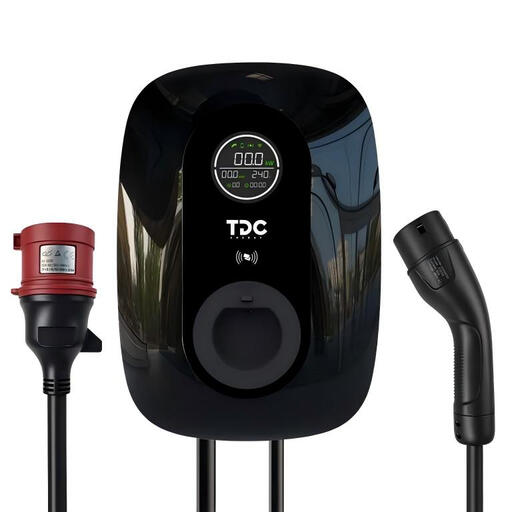
Why it suits this profile: A tethered wallbox for those who have a suitable 400 V 3-phase supply at home and want to combine app and RFID control.
The specifications clearly state 400 V, 3-phase, max. 16 A, and a CEE 5-pin plug. This makes it easier to check if your connection is compatible beforehand.
11 kW AC charging, 5-metre tethered cable, 3-inch screen, app and RFID control, and listed leakage current detection.
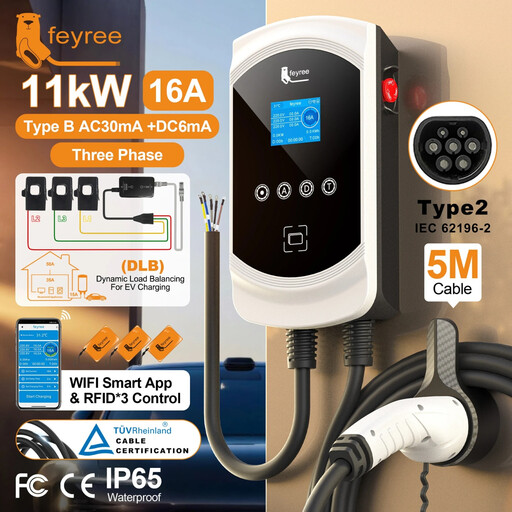
Why it suits this profile: Aimed at users who value charging scheduling, monitoring, and automatic adjustment to household energy consumption.
The product description mentions dynamic load balancing. According to feyree's product description, the charger adjusts the charging current based on other household energy consumption.
11 kW and 16 A, Tuya app, charge scheduling, 2.8-inch colour screen, RFID function, and listed Type B leakage current protection.
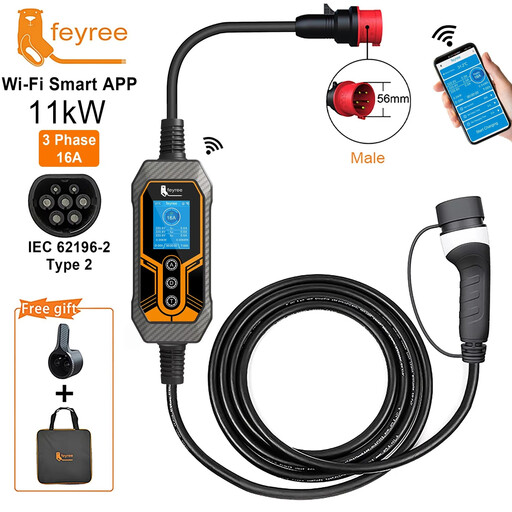
Why it suits this profile: Useful for those who use a 3-phase CEE connection and want a portable charger to take with them or use in different locations.
The description mentions a CEE connection, adjustable current from 8 to 16 A, and an LCD screen. However, be sure to check the type of CEE socket and the available circuit beforehand.
Up to 11 kW according to the product description, 5-metre cable, Wi-Fi app, Bluetooth, charge scheduling, and adjustable charging current.
We have compiled a complete, up-to-date list of products that fully meet these strict selection criteria and comply with current European safety regulations.
No. An 11 kW charger typically requires a suitable 400 V 3-phase supply. An electrician must check that your main fuse, wiring, RCD protection, and consumer unit have sufficient capacity. If you have a single-phase supply, a 7.4 kW or 3.5 kW solution may be more logical.
That depends on the battery capacity and the car's maximum AC charging rate. A car that supports 11 kW 3-phase charging can theoretically receive about 11 kWh per hour. In reality, charging losses, temperature, and the car's charging strategy can affect the time.
The charging cost is mainly determined by the number of kilowatt-hours you use and your electricity tariff. An app with charge scheduling can help you set charging sessions for times with a lower tariff, if your energy supplier offers one. You should also consider the standby power consumption, installation costs, and any potential fees for an internet connection or app service.
