
Vandaag of morgen in huis

Kwaliteit gegarandeerd

Welkomstaanbiedingen ontgrendelen: GRATIS bezorging | Tot 80% korting | Gratis 30 dagen JoyPlus-proefperiode
Download de app
An 11 kW Type 2 EV charger might seem straightforward to choose on paper. However, differences in the connection, charging cable, safety features and controls can determine whether a charging station is right for your home and car. EV drivers in the Netherlands with a three-phase connection often encounter the same issues: a charger that doesn’t deliver the expected power, a cable that’s too short or an app that only works when the network connection is stable.
This buying guide will help you check the key specifications and assess the practical value of marketing claims.
An 11 kW charging station delivers a maximum of around 16 A at 400 V across three phases. However, your car must also support this charging power through its onboard AC charger. Some electric cars and plug-in hybrids only charge at 3.7 kW or 7.4 kW on AC. In that case, an 11 kW wallbox won’t automatically charge your car faster.
Before buying, check that:
App controls are useful for setting charging times, monitoring electricity use and starting or stopping a charging session. They usually require Wi-Fi, Bluetooth or a compatible network connection, though. An app function is no substitute for local controls.
An RFID charging station can be useful if you also want to manage access without a network connection. Check how many RFID cards are included and whether the charging station can start without the app. On some models, RFID is only used for authorisation, while other functions still require the app.
An EV charging station may have an IP rating for protection against dust and water, but that doesn’t mean it can be exposed without limit to rain, splashing water or a pressure washer. A sheltered location, such as a garage or carport, is still a sensible choice.
Also check the difference between the charging unit and the vehicle connector. According to the product description, the TDC ENERGY RAC11 connector is rated IP54 when placed in its holder and IP65 when the protective cap is fitted. These ratings apply to different situations.
A typical 16 A 400 V EV charger uses a three-phase connection. In practice, this means the installation must be suitable for three phases, neutral and earth. Some models can use a 5-pin 16 A CEE connection, but a qualified electrician must check the connection and safety features.
The actual charging speed depends on:
A model with dynamic load balancing can adjust its charging power to match current household electricity use. According to the product descriptions for some Feyree models, this function monitors the use of other appliances and reduces the charging current when needed. Check in advance whether it requires a separate meter, sensor or specific installation.
Don’t just look at how many safety features are listed; check the exact specifications too. Many models list protection against overload, overvoltage and undervoltage, overheating, short circuits and earthing faults.
The TDC ENERGY RAC11 product description lists Type A RCBO AC 30 mA + DC 6 mA leakage detection, among other features. Other wallboxes specify Type B protection or built-in DC detection. Ask an electrician to determine which combination your installation requires. A charging station shouldn’t simply be connected to an existing circuit without checking the cable cross-section, residual-current protection and electrical load.
A 5-metre Type 2 charging cable is practical for many garages and driveways, but measure the distance between the wallbox and your car’s charging port. Take into account any obstacles, where you park and how the cable will be stored.
A tethered cable is quick to use. A socketed version offers more flexibility, but often requires a separate Type 2-to-Type 2 cable. Always check what’s included in the box. Wall mounting saves space, but the wall or mounting post must be sturdy enough.
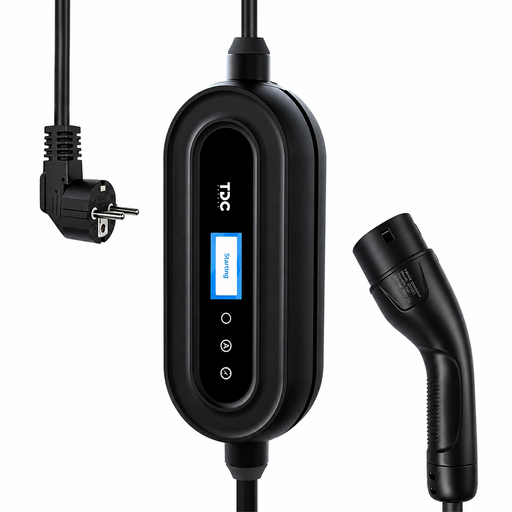
Why it suits this user: This EV charger is portable and uses a standard, compatible 230 V Type F socket. It’s a good option if you want to start charging with minimal fuss, without installing a fixed 11 kW wallbox straight away.
The charging current can be set to 8, 10, 13 or 16 A, so you can match the setting to the socket and circuit. This isn’t an 11 kW charger, but it does help you avoid buying a more powerful installation than you need.
Maximum power of 3.5 kW, 5-metre cable, LCD screen and control via app, button or Plug & Charge. The product description specifies IP66 protection.
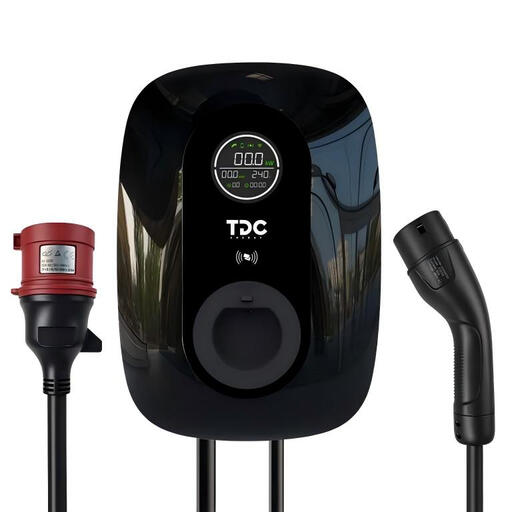
Why it suits this user: This fixed three-phase EV charger is designed for home or garage use with a suitable 400 V installation. Its integrated cable, display, RFID and app make it well suited to everyday charging.
The specifications explicitly state 400 V, three phases, a maximum of 16 A and a 5-pin 16 A CEE plug. However, check with your electrician that this connection can be installed appropriately at your home.
11 kW AC charging, 5-metre Type 2 cable, 3-inch segment display, Wi-Fi and Bluetooth. The product description also lists protection against overload, overheating and leakage current.
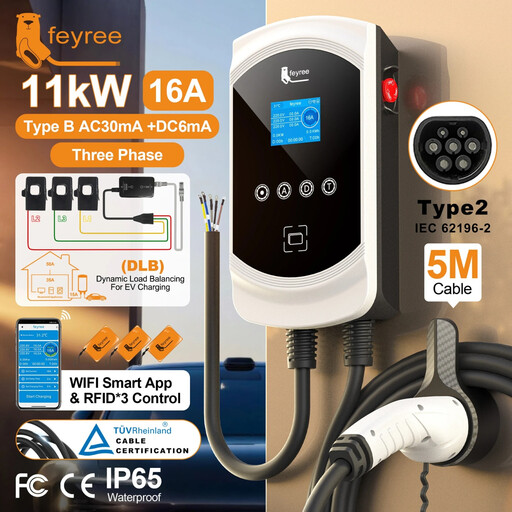
Why it suits this user: The advertised dynamic load balancing is useful for households with solar panels, a heat pump or several high-power appliances running at the same time.
According to the product description, the wallbox adjusts the charging current to match household electricity use. Ask in advance how the load-balancing function is connected and which accessories are required.
11 kW, Type 2, Wi-Fi app, RFID, adjustable charging current and a colour display. The product information also lists protection against overheating, earth leakage, overvoltage and undervoltage.
We’ve put together a complete, up-to-date list of products that meet these strict selection criteria and comply with current European safety regulations.
Plan the installation only after checking the following:
According to the product information, installation and commissioning must be carried out by a qualified electrician and in line with local regulations.
It depends on the onboard charger and battery capacity. A car that supports 11 kW three-phase charging can theoretically receive around 11 kWh per hour. A model that only supports 3.7 kW will continue to charge at that lower power.
Yes. A suitable three-phase installation with 400 V is generally needed to deliver the full 11 kW. An electrician should assess the consumer unit, cables, residual-current protection and available grid capacity.
Charging costs are mainly determined by the number of kilowatt-hours charged and your electricity tariff. The wallbox itself doesn’t automatically determine the cost of each charge. If your app lets you schedule charging times, you may be able to take advantage of cheaper off-peak rates under your energy tariff, if available.
