
Vandaag of morgen in huis

Kwaliteit gegarandeerd

Welkomstaanbiedingen ontgrendelen: GRATIS bezorging | Tot 80% korting | Gratis 30 dagen JoyPlus-proefperiode
Download de app
As a Product Recommendation Officer at Joybuy, I see people struggle daily with choosing a charging solution. The market for electric cars is growing rapidly, and with it, the range of available chargers. An 11kW mobile charger seems like the ideal, flexible solution. But in practice, the reality is more complex. Many buyers fall into common traps that lead to frustration and unnecessary costs. Let's cut through the marketing hype and look at what you really need to pay attention to.
Before you purchase a portable charger for your electric car, it's crucial to know where things often go wrong.
You don't need to be an electrician to make an informed choice. Focus on these three concrete points.
An 11kW mobile charging station runs on three-phase power. This is also referred to as a 3-phase 16A charging station. The math is simple: 3 (phases) x 230V (voltage) x 16A (amperage) ≈ 11,000 Watts, or 11kW. So, first, check your electrical panel. Do you have a 3-phase connection? If so, you can utilize the full speed. Most modern electric cars in Europe use a Type 2 connector, so a type 2 11kW charging cable is typically the correct standard.
A smart charger with an app is more than just a gadget. Its most important function is the ability to schedule charging sessions. This allows you to automatically charge your car at night during off-peak hours when electricity rates are lower. A good app also provides insight into your consumption and allows you to adjust the charging current (Amperage). This is useful if you are using other high-consumption appliances simultaneously and want to prevent overloading the circuit.
A mobile EV charger is meant to be portable. Look for a robust casing and an IP rating (water and dust resistance) of at least IP55 if you plan to use it outdoors. Always verify that the charger is equipped with the necessary protections:
Based on these objective criteria, we have selected several models that suit different user profiles.
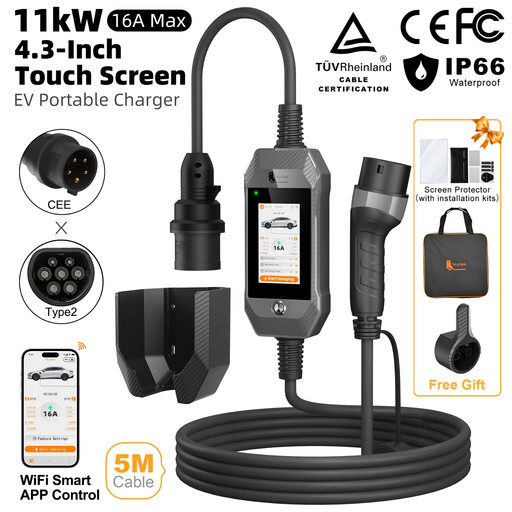
Why This Fits Their Persona: For those who want to know and control everything. The clear touchscreen provides instant insight into charging status, power, and consumption, without needing to grab your phone first. The app also offers detailed charging history and the ability to receive firmware updates (OTA).
This charger combines 11kW 3-phase power with a clear interface that shows the current charging status, so you can immediately see if you're getting the promised speed. The app makes scheduling charging sessions simple.
Instant feedback: The 4.3-inch touchscreen is unique in this category. Comprehensive safety: According to the manufacturer, the model features Type B (AC30mA + DC6mA) leakage protection and temperature monitoring.
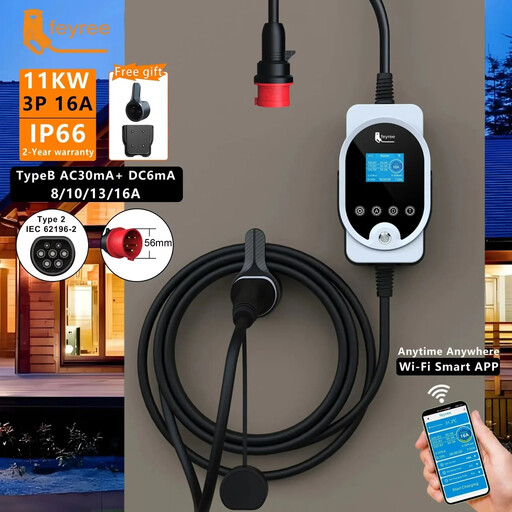
Why This Fits Their Persona: Ideal for those who primarily charge at home but also want to take the charger to a holiday destination or work. This model offers the necessary 11kW speed and smart app features without unnecessary extras. The included wall bracket makes it a practical `home car charger` that you can easily disconnect.
This model focuses on the essentials: reliable 11kW charging with the right safety features. The app functionality is geared towards cost savings by scheduling charging sessions, which is a common desire.
Dual use: Functions as both a fixed wallbox (with bracket) and a `mobile EV charger`. Full control: The amperage is adjustable via the app or buttons (8/10/13/16A) to adapt to any situation.
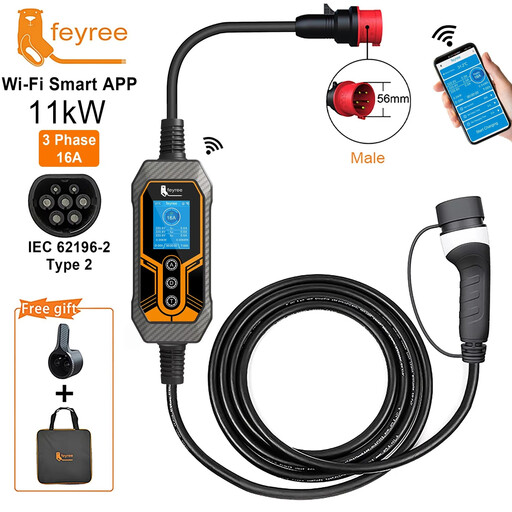
Why This Fits Their Persona: For the user who charges at various locations and can't always rely on a stable Wi-Fi signal. The addition of Bluetooth ensures you can still configure and operate the charger when there's no internet, for example at a campsite or in a parking garage.
Many 'smart' chargers become useless without Wi-Fi. This model bypasses that problem with Bluetooth connectivity, ensuring smart features like adjusting the charging current remain available at all times.
Dual connectivity: Works via both Wi-Fi and Bluetooth for maximum flexibility. Robust and safe: The manufacturer specifies an IP66 rating for the connector and a rugged TPE cable, suitable for heavy use.
We have compiled a complete, up-to-date list of products that meet these strict selection criteria and safety standards.
Yes, to achieve the maximum charging power of 11kW, a 3-phase connection (also known as three-phase power) with a CEE plug (the red, 5-pin plug) is necessary. You can often connect the charger to a 1-phase outlet, but the charging power will be significantly lower, typically a maximum of 3.7kW.
The main advantage is cost savings. By scheduling your charging sessions during off-peak hours (usually at night and on weekends), you pay a lower electricity rate. This can result in significant annual savings on your energy bill. It also helps to avoid overloading your home's electrical grid during peak times.
Although many mobile chargers have a high IP rating (like IP66), they are primarily designed for portability. The control box and plugs contain sensitive electronics. For permanent outdoor use, exposed to the elements, a fixed wallbox specifically designed and installed for that purpose is often a more durable solution. If you use a mobile charger outdoors, ensure the control box is sheltered and not lying in a puddle of water.
