
Vandaag of morgen in huis

Kwaliteit gegarandeerd

Welkomstaanbiedingen ontgrendelen: GRATIS bezorging | Tot 80% korting | Gratis 30 dagen JoyPlus-proefperiode
Download de app
An 11 kW EV charger Type 2 is worth considering if your electric car has a three-phase onboard charger and you want to charge at home faster than a standard socket can manage. However, the difference between a suitable Type 2 wallbox and a disappointing purchase isn't just about wattage.
You need to pay close attention to your home's electrical connection, your car's charging capabilities, and how the charger handles faults. Marketing terms like "super-fast", "smart" and "universal" don't tell you much on their own. It's the technical specifications that determine whether a home charging point actually suits your situation.
An 11 kW charging station can only charge at this level if:
If your car only has a single-phase onboard charger, the available capacity won't be fully used. According to feyree's product information, a vehicle without three-phase support may charge at a lower level, depending on the onboard charger.
A fixed 32A setting isn't practical for every home. Other appliances, solar panels or a limited mains connection can affect the available capacity. A charging station with an adjustable current, for example from 8A to 32A, gives you much more flexibility.
Bear in mind: a lower setting doesn't replace a proper electrical installation. Have a qualified electrician assess which circuit, residual current protection and cabling are needed.
A smart charger with an app can be handy for starting, stopping, scheduling and checking your usage. That doesn't automatically mean the charger also supports dynamic load balancing or makes the most of surplus solar power.
So check exactly which features are available. According to the product description, the feyree 11 kW EV charger offers control via the Tuya app, including setting the current, charging time and notifications. Before you buy, make sure your Wi-Fi signal and smartphone are compatible.
For most electric cars in the UK, Type 2 is the standard connection for AC charging. The term IEC 62196-2 charging station refers to the technical standard for these charging connectors and sockets.
Check whether your car actually has a Type 2 inlet and whether the charging station uses a cable or a Type 2 socket. A socket version can be more flexible, but you'll need a separate Type 2 to Type 2 cable. The feyree 11 kW version is described as a socket model in the product information, so check the package contents.
A three-phase EV charger at 11 kW works differently from a 7 kW charger on 220V. The key points are:
The charging speed is ultimately limited by the lowest capacity among the car, the wallbox and the electrical installation.
For a charger mounted outdoors, the housing and safety features are important. The feyree models list IP65, protection against over-voltage and under-voltage, over-current, overheating, short circuit, earth leakage and lightning. These are product specifications from the description; actual safety also depends on correct installation and connection.
IP65 doesn't mean you can submerge any device under all conditions. Install the charger according to the manual, avoid damaged cables and keep the connections clean and dry.
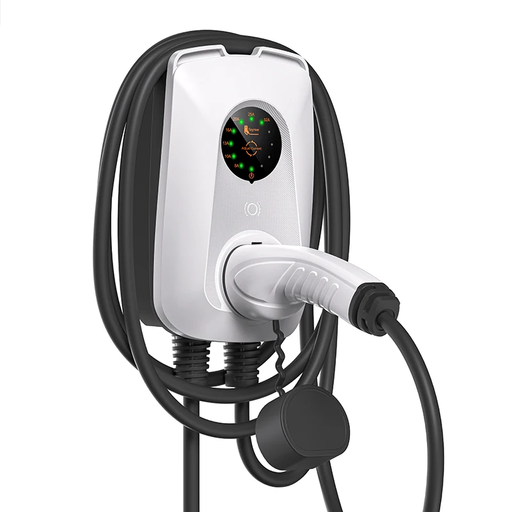
Why this fits the profile: This wall charger is ideal if you want to charge at home without jumping straight to an 11 kW installation. The current is adjustable in seven steps and the cable is 5 metres long.
The adjustable current means you're not stuck with a fixed 32A setting. Just check that single-phase 7 kW is suitable for your car and fuse box.
7 kW output power, Type 2 connection, adjustable from 8A to 32A and IP65 housing according to the product description.
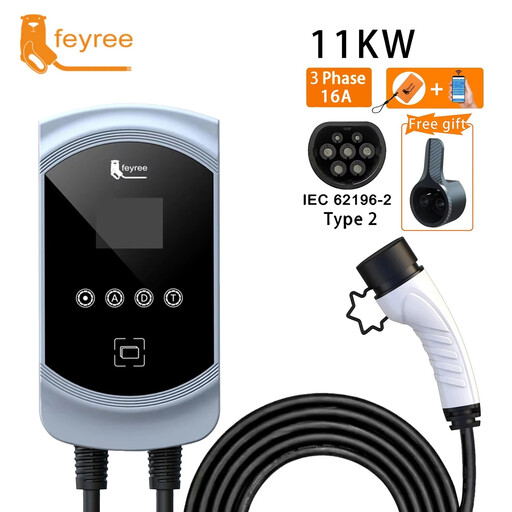
Why this fits the profile: This model suits owners of an electric car with a Type 2 inlet, a three-phase connection and a desire for smartphone app control.
The product information explicitly mentions support for 11 kW three-phase AC charging, adjustable current and a Type 2 socket. Check beforehand whether you need a separate charging cable.
11 kW, 32A setting, Tuya app with scheduling and notifications, plus multiple listed safety features.
Why this fits the profile: If you regularly cover long distances, you'll appreciate scheduled charging, remote control and a clear status display. According to the product description, these features are offered via the Tuya app.
The adjustable current and scheduled charging time let you tailor the charger to your usage patterns. Load balancing isn't listed as a feature, so don't assume it's included.
Wi-Fi control, charging scheduling, RFID function, LED status display and adjustable current from 8A to 32A according to the product information.
We've put together a full, up-to-date list of products that fully meet these strict selection criteria and comply with current European safety regulations.
Charging your electric car at home with 11 kW requires more preparation than plugging a mobile charger into a socket. Before you buy, have the following checked:
Mount a wallbox in a spot where the cable won't cross a walkway. A cable holder, like the one mentioned with the 7 kW version, helps keep the cable tidy. Also check the plug, cable and housing regularly for visible damage.
That depends on the battery capacity, the charge level and your car's onboard charger. A car with an 11 kW three-phase onboard charger will use the wallbox differently from a model that only supports 3.7 or 7.4 kW. Divide the usable battery capacity by the actual charging power for a rough estimate.
Not at its full rated capacity. Without a suitable three-phase connection, the charger may charge at a lower level, but this must match your installation and your car's specifications. Have an electrician assess this beforehand.
The cost depends on the number of kilowatt-hours charged and your electricity tariff. The 11 kW power mainly determines how quickly you charge; it doesn't directly set the price per charge. An app that shows usage and charging time makes it easier to keep track.
