
Vandaag of morgen in huis

Kwaliteit gegarandeerd

Welkomstaanbiedingen ontgrendelen: GRATIS bezorging | Tot 80% korting | Gratis 30 dagen JoyPlus-proefperiode
Download de app
A 1000W stand mixer might seem ideal for bread dough, cake batter and whipped cream. But wattage doesn’t tell the whole story. One model may have a peak power of 1000W, while its stated rated power is lower. A large mixing bowl, lots of accessories or a supposedly quiet motor may also perform differently in practice than you expect.
For home bakers, families and keen cooks, three things matter most: the motor’s actual power, the bowl’s usable capacity and the quality of the included accessories. Read on to find out what to look for before you buy a stand mixer.
A product title featuring “1000W” sounds impressive, but check whether this refers to peak power or rated power. The Monsga SM100, for example, is listed with 1000W peak power, while the product information also states 600W rated power. That difference matters if you regularly make heavy bread dough.
A higher wattage also doesn’t automatically mean the machine will knead better. The gearing, planetary mixing action and stability of the housing all play a part.
A stand mixer with a 5-litre bowl may sound appealing for families. However, check whether the stated capacity is the maximum or the recommended amount. According to the product specifications, the Monsga has a 6-litre bowl, with a recommended usable capacity of 5 litres.
When making dough and batter, it’s best to follow the maximum capacity in the manual. Overfilling the bowl can lead to splashing, uneven mixing or extra strain on the motor.
No stand mixer is completely silent. Noise levels depend on the speed, recipe and type of worktop. The Monsga SM100 is listed with a noise level of 75 dB. This is a measurable specification, but it doesn’t guarantee that the appliance will feel quiet in every situation.
Place your stand mixer on a stable, level worktop. A wobbly table or a hard, resonant surface can make it seem noisier.
Kneading, mixing and whisking require more than just a high number on the box. Look out for:
For bread dough, you’ll usually want to use a low to medium speed. Always follow the manufacturer’s instructions and don’t exceed the maximum dough capacity.
A stand mixer with a 5-litre bowl is suitable for many everyday recipes, but consider the shape and material too. A stainless steel bowl is sturdy and won’t absorb food odours. A handle can make pouring and moving the bowl easier.
According to the product information, the Monsga comes with a 304 stainless steel mixing bowl. Its stated capacity is 6 litres, with 5 litres as the recommended capacity. This makes it suitable for family-sized batches, as long as you follow the quantities in the manual.
A stand mixer for baking is only versatile if its accessories suit the recipes you make. The basics usually include:
The Monsga is listed with a whisk, beater, dough hook, splash guard and egg separator. According to the product description, the accessories are dishwasher-safe. Before use, check that each part is securely locked in place, and unplug the mixer before changing accessories.

Why it suits this profile: This stand mixer combines a roomy stainless steel bowl with 8 speeds and several essential accessories for cakes, biscuits, whipped cream and dough.
The product specifications list both 1000W peak power and 600W rated power. This gives you a more realistic picture of its power than the title alone.
8 speeds, a 6-litre bowl with a recommended usable capacity of 5 litres, plus a dough hook, whisk and splash guard.
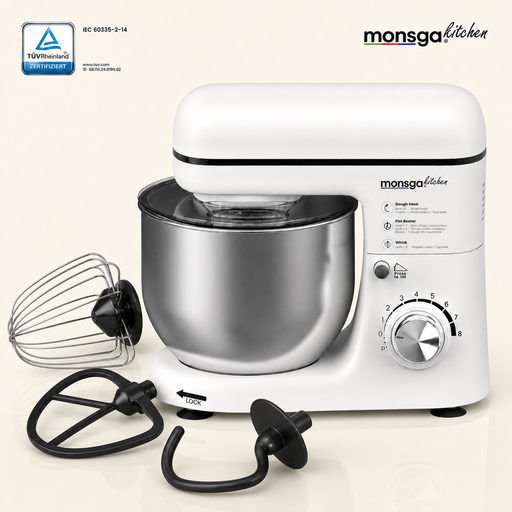
Why it suits this profile: If you value materials, ease of use and build quality, this stand mixer features a stainless steel bowl, a tilt-head design and non-slip feet.
The recommended bowl capacity is listed separately from the total capacity. The noise level is also stated as 75 dB, rather than relying solely on the word “quiet”.
Tilt-head motor, four silicone suction feet and accessories that are listed as dishwasher-safe in the product information.
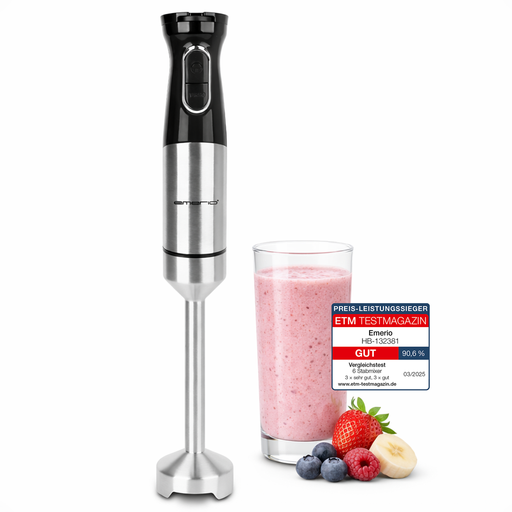
Why it suits this profile: A hand blender is more practical than a stand mixer for soups, sauces and smoothies. This model won’t replace a stand mixer with a dough hook, but it makes a useful addition for specific tasks.
You won’t pay for a large bowl and accessories you don’t need if you mainly blend liquid or soft ingredients.
1000W motor, variable speed and a removable stainless steel blending shaft. Not suitable for bread dough or whipping large quantities of cream.
We’ve put together a full, up-to-date list of products that meet these strict selection criteria and comply with the applicable European safety regulations.
That depends on the rated power, the amount of dough and the machine’s construction. As well as checking the peak power, look at the stated rated power and maximum dough capacity. For kneading, you’ll usually want to use a low to medium speed.
The usable capacity varies by recipe. A 5-litre bowl isn’t designed to be filled to the brim every time. With yeast dough and batter, allow for rising and splashing. Always follow the manufacturer’s recommended quantity.
A 1000W appliance theoretically uses 1 kilowatt-hour if it runs continuously at that power for one hour. In practice, consumption varies depending on the speed, load and length of use. With a model that has a lower rated power, actual consumption during normal use may differ from what the title suggests.
